

What is GraphAir™?
Engineered for Frictionless Motion
GraphAir™ Bearing Technology is OAV’s proprietary method of using aerospace-grade porous graphite to distribute pressurized air uniformly across the entire bearing surface. GraphAir™ technology is the foundation of every porous graphite air bearing OAV manufactures — from bushings and rollers to full multi-axis motion systems.
This creates a stable, self-compensating air film (3–10 microns thick) that eliminates mechanical contact — resulting in zero friction, zero wear, and ultra-smooth motion.
Unlike orifice-based air bearings that rely on discrete holes, GraphAir™ distributes air through millions of sub-micron pores, creating a natural averaging effect that improves stability, stiffness, and motion accuracy.
How GraphAir™ Technology Works
Uniform Air Distribution. Superior Performance.

GraphAir™ technology uses a fully porous graphite matrix to create a self-regulating air film that maintains uniform pressure across the entire bearing surface.
COMPRESSED AIR IN
Clean, dry air enters the bearing inlet.
UNIFORM AIR FILM (3-10 µm)
A stable, self-compensating air film separates the bearing from the motion surface with no mechanical contact, no friction, and no wear.
MOTION SURFACE
The air film averages microscopic surface irregularities, delivering smooth, repeatable motion.
POROUS GRAPHITE MATRIX
Millions of interconnected sub-micron pores evenly distribute air uniformly across the entire bearing surface.
Self-Compensating Air Film - Automatically Maintains Precision
The porous graphite structure automatically adjusts pressure across the surface to maintain a stable air gap under changing loads.

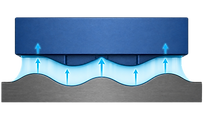
GAP NARROWS
Increased resistance builds pressure locally, lifting the load and restoring the gap.
GAP WIDENS
Reduced resistance lowers pressure locally, allowing the load to re-center.
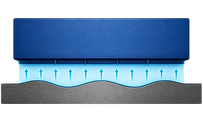
PERFECT BALANCE
Continuous micro-adjustments across the surface for maximum stability, stiffness, and damping.
GraphAir™ Dual Pore Structure Design
Dual-Porosity Graphite Structure. Engineered for Maximum Stability
The GraphAir™ process creates a sophisticated dual-pore structure consisting of macropores for primary air flow and micropores for fine pressure regulation. This hierarchical pore architecture achieves optimal gas permeability while maintaining the structural integrity required for high-stiffness applications. The controlled porosity ensures maximum bearing capacity without compromising material strength.
Performance Comparison: GraphAir™ vs. Traditional Technologies
Performance
Metric
GraphAir™
Porous
Orifice
Compensated
Inherently
Compensated
Excellent (100 %)
Stiffness
Load Capacity
Stability
Maintenance
Cleanroom
Compatible
Superior (100 %)
Excellent
Zero
ISO Class 1-3
Moderate (35 %)
Good (75 %)
Variable
Low (25 %)
High
Limited
Moderate (60 %)
Poor
Moderate
Limited
GraphAir™ Performance Data & Comparison
Quantified Performance for Precision Motion Systems
GraphAir™ technology delivers industry-leading accuracy, stability, and reliability for the most demanding motion applications.
GraphAir™ Performance Specifications
The following specifications apply to OAV's GraphAir™ based linear air bearing guides. Individual product specifications vary - consult the relevant product datasheet or contact OAV engineering.
Local Straightness
Maximum Accumulated Error
Flatness
Air Film Thickness (Typical)
Operating Pressure Range
Minimum Start Pressure
Friction
Wear Rate
Maintenance Interval
Contamination
Certification
0.25 µm per 25 mm of travel
2 µm per 1000 mm of travel
3 - 10 µm
0.0005 mm (0.00002 in)
40 - 100 PSI (compressed dry air)
40 PSI recommended
Zero (no mechanical contact)
Indefinite (no lubrication required)
None (no lubricants or particulates)
ISO 9001:2015, AS9100 Rev D
Zero (no mechanical contact)
Built For Critical Applications
Industries That Rely on GraphAir™
Proven across aerospace, semiconductor, and precision metrology applications.
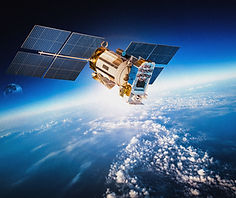
Aerospace
Satellite testing, inertial navigation, and precision motion systems.

Automation
Wafer handling, metrology, and lithography equipment.
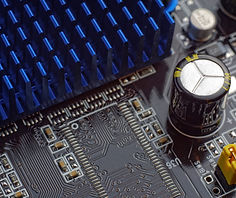
Semiconductor
High-precision positioning, robotics, and motion control.

Optics & Metrology
Interferometry, inspection systems, and research instrumentation.