DESIGN GUIDE
Linear AIR BEARINGS Design and Installation Guide
This guide provides engineering best practices for the design, preload configuration, and installation of OAV Linear Air Bearings. Follow these recommendations to achieve optimal performance, stiffness, and accuracy.
01
Guide Series Overview
OAV offers multiple linear air bearing guides to meet a wide range of load, stiffness, and system integration requirements. Select the series that best fits your application and review the corresponding installation guidelines below.
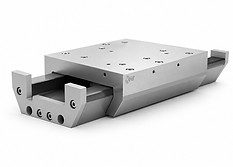
Dovetail Series
Precision linear guide system for ultra-smooth motion, high stiffness, and exceptional positioning accuracy.
Key Features
-
Frictionless, zero-wear motion
-
High straightness and flatness accuracy
-
Ideal for metrology and precision positioning
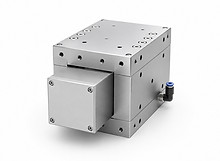
Box Series
Enclosed air bearing carriage design engineered for high rigidity, multi-axis integration, and vibration-free motion.
Key Features
-
Frictionless, zero-wear motion
-
High structural stiffness
-
Integrated locking/brake functionality
-
Multi-side mounting capability
-
Excellent positional repeatability
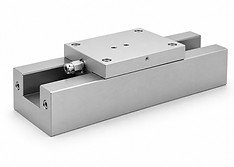
T-Series
Vacuum-preloaded open-profile guide optimized for precision linear motion and modular system integration.
Key Features
-
Frictionless, zero-wear motion
-
Air + vacuum preload technology
-
Easy-access open-profile geometry
-
Suitable for precision automation systems
Design & Installation Guides
Modular Air Bearings
Tapered Air Bearings
Linear Guide Air Bearings
All OAV Linear Guide Series are precision-engineered for non-contact, frictionless motion and long-term positioning accuracy.
02
General Installation Considerations
The following installation considerations apply across all OAV Linear Guide Series. Proper alignment, clearance verification, and clean assembly are critical to achieving stable air film performance.
Clean Assembly
Use lint-free wipes and isopropyl alcohol only to clean guide rails and mounting surfaces. Do not apply oil or grease to air bearing surfaces.
Alignment
Verify rail straightness, mounting flatness, and system parallelism before installation. Use precision dowel pins or locating features where applicable.
Air Film Verification
Confirm stable air film formation and smooth non-contact carriage motion before operation. Ensure clean, regulated air supply throughout startup.
Startup Verification
Apply air pressure and move the carriage through full travel to verify smooth motion, stability, and proper system integration. Check for vibration, drag, or misalignment.
03
Dovetail Series
The OAV Dovetail Series Linear Air Bearing Guides deliver ultra-precise straightness, high stiffness, and frictionless motion through a porous graphite air bearing design. Engineered for precision positioning and metrology applications, the dovetail profile provides exceptional positional stability, smooth motion, and long-term repeatability.
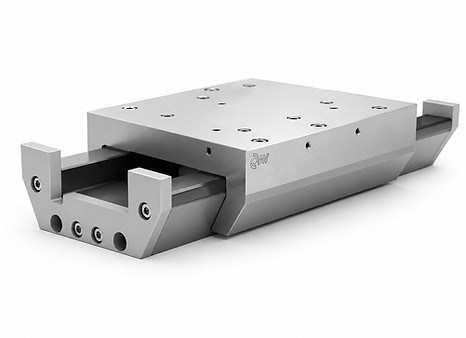
Carriage
Guide Rail
Optional Air-Inlets All Sides
Endplate Pre-Tapped Holes
Carriage Pre-Tapped Mounting Holes
Integrated Locking Function
Pre-tensioned air bearing geometry provides passive holding capability for improved positioning stability.
Precision Straightness
Engineered for high linear accuracy, flatness, and repeatable non-contact motion.
Maintenance-Free Operation
Porous graphite air bearing surfaces eliminate wear and reduce maintenance requirements.
04
Dovetail Series Installation Notes
The following installation notes apply specifically to OAV Dovetail Series Linear Air Bearing Guides. Proper mounting flatness, carriage alignment, and fastening procedures are critical to maintaining ultra-precise linear motion and positional stability.
Mounting Surface
Ensure the mounting surface is flat, rigid, and free from contaminants or surface distortion before installation.
Rail Alignment
Maintain parallelism and straightness throughout installation to prevent binding or uneven carriage motion.
Carriage Fastening
Tighten mounting hardware gradually and evenly. Avoid overtightening, which may affect guide flatness and motion accuracy.
Motion Verification
After installation, move the carriage through full travel to verify smooth non-contact motion and positional stability.
05
Box Series
The OAV Box Series Linear Air Bearing Guides are engineered for ultra-precise straightness, high rigidity, and vibration-free linear motion through a porous graphite air bearing design. The enclosed carriage architecture provides excellent structural stability, multi-side mounting flexibility, and maintenance-free frictionless operation for precision positioning applications.
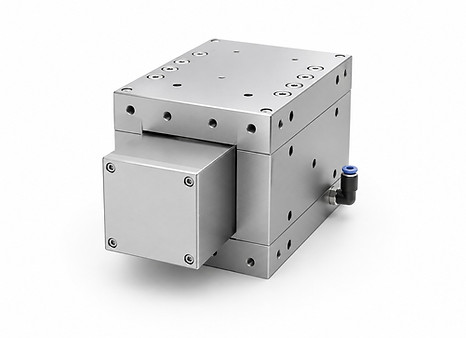
Box Carriage
Guidebar
Optional Air-Inlets All Sides
Carriage Pre-Tapped Mounting Holes
Integrated Locking Function
Pre-tensioned air bearing geometry provides passive holding capability for improved positioning stability and repeatable motion control.
High Structural Rigidity
Enclosed carriage construction delivers exceptional stiffness, flatness accuracy, and stable linear motion under load.
Maintenance-Free Operation
Porous graphite air bearing surfaces eliminate wear and reduce maintenance requirements.
06
Box Series Installation Notes
The following installation notes apply specifically to OAV Box Series Linear Air Bearing Guides. Proper mounting flatness, rail alignment, and fastening procedures are critical to maintaining vibration-free motion and long-term positional accuracy.
Mounting Surface
Ensure the installation surface is flat, rigid, and free from contamination before mounting the guide system.
Rail Parallelism
Maintain rail straightness and parallel alignment throughout installation to prevent binding or uneven carriage motion.
Mounting Hardware
Use pre-drilled mounting holes and tighten hardware evenly. Avoid overtightening, which may affect motion accuracy.
Motion Stability
Verify smooth carriage travel and stable motion after installation. Recheck alignment and hardware if irregular movement occurs.
07
T-Series
The OAV T-Series Linear Air Bearing Guides are engineered for ultra-precise linear motion using porous graphite air bearing technology and vacuum-preloaded geometry. The open-profile rail design provides smooth non-contact motion, exceptional positioning accuracy, and stable vibration-free operation for precision automation and metrology applications.
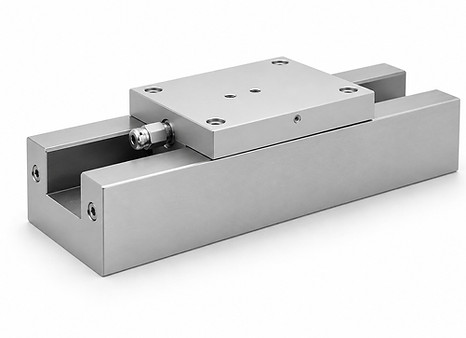
Carriage
Guide Rail
Air / Vacuum Ports
Endplate Pre-Tapped Holes
Carriage Pre-Tapped Mounting Holes
Vacuum Preload Technology
Combined air pressure and vacuum preload maintain stable carriage constraint for improved precision and motion stability.
Precision Linear Accuracy
Engineered for repeatable non-contact motion with high straightness, flatness accuracy, and smooth linear travel.
Open-Profile Integration
Accessible rail geometry allows simplified mounting, integration flexibility, and efficient multi-axis system design.
08
T-Series Installation Notes
The following installation notes apply specifically to OAV T-Series Linear Air Bearing Guides. Proper mounting flatness, vacuum preload stability, and rail alignment are critical to achieving accurate non-contact linear motion and long-term repeatability.
Mounting Surface
Ensure the installation surface is flat, rigid, and free from contamination before mounting the guide system.
Rail Alignment
Maintain rail straightness and parallel alignment throughout installation to prevent binding or uneven carriage motion.
Vacuum Stability
Verify stable air and vacuum supply during operation to maintain proper preload and non-contact carriage motion.
Motion Stability
After installation, move the carriage through full travel to confirm smooth motion, stability, and proper alignment.